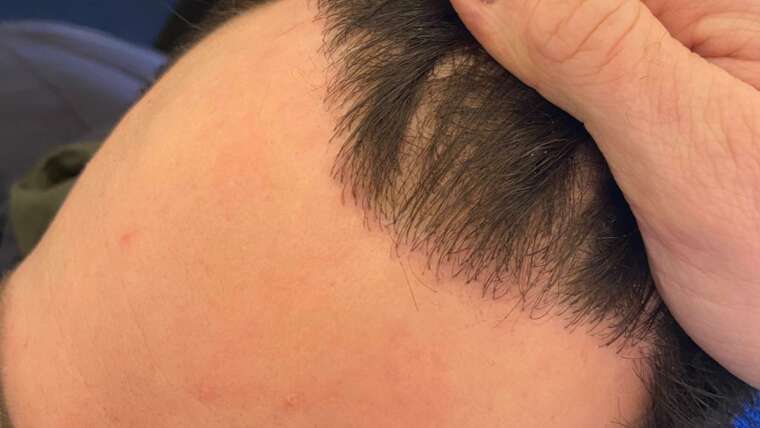

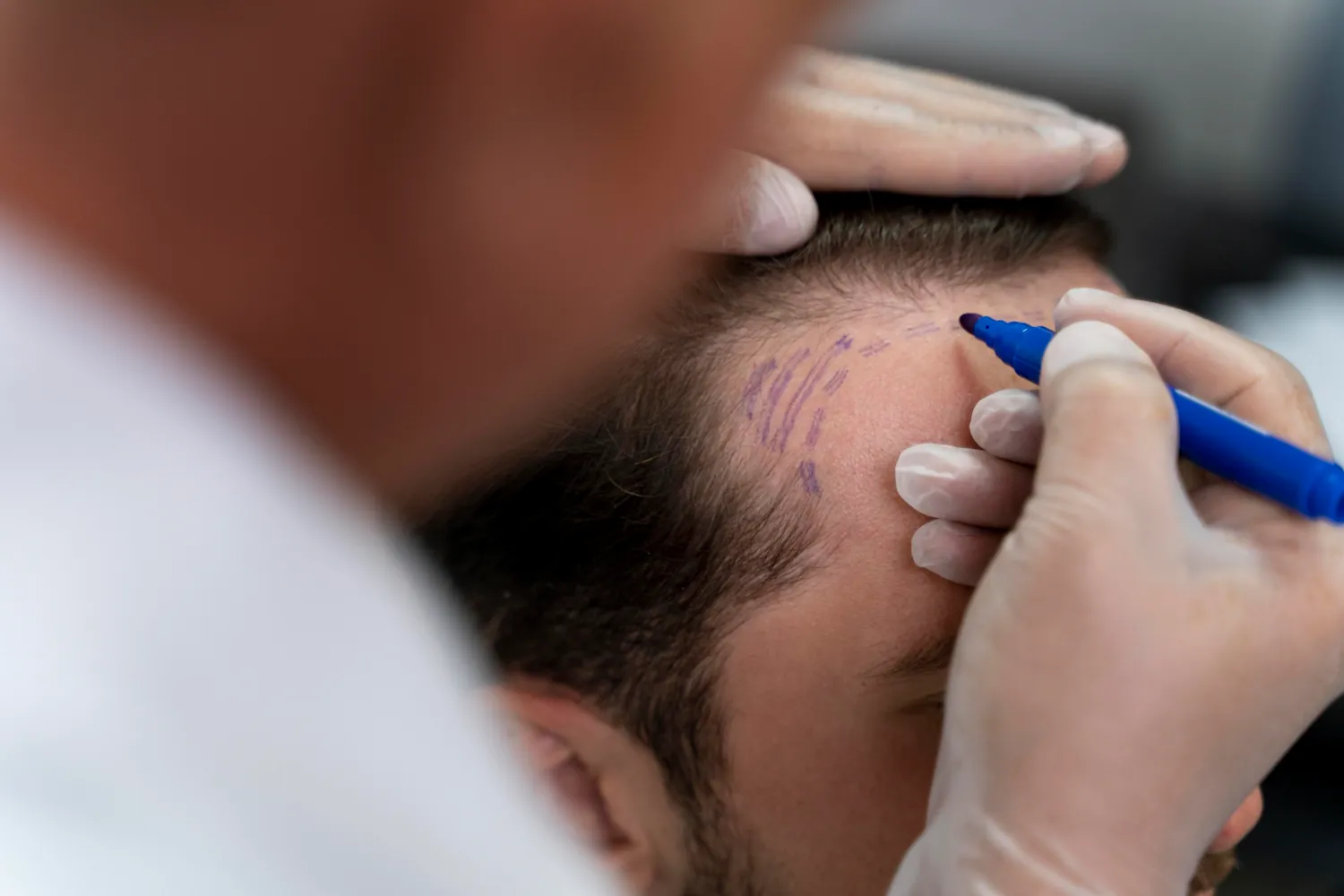
Points to evaluate and or modify / correct:
- overall shape of the HL
- direction of the transplanted hairs
- angle of growth of the transplanted hairs
- height of the HL
- density of the transplanted hairs
- irregularities (zigzag line) of the HL
1. Modification of the overall shape of the HL depends on the presence of previously transplanted hairs, in the wrong areas and specifically on the forehead.
In such case, the incorrectly placed hairs can be taken out (extracted) with a punch (no scars made on the skin) and afterwards the new HL can be created. This whole process may not be completed in one operation.
In case additional hairs are simply needed for overall re shaping of the HL, then this can be done with another hair transplant.
2. Modification / correction of wrong direction and wrong angle of growth of the previously transplanted hairs cannot be done successfully with another hair transplant.
3. Modification of height of the HL at a lower level (always up to the natural limit of the forehead) can be easily done with another hair transplant.
4. Improvement i.e. increase of hair density can be done by a very experienced surgeon. The additional hairs must be safely placed in gaps of proper size in between the existing previously transplanted hairs as well as in the precise direction and angle of placement so that these existing hairs are not damaged at all by the implanters.
5. Shaping the HL irregularities (zigzag line), (small asymmetrical hair protrusions that form the anterior zigzag boundary of the HL), is a major improvement of the HL as it makes it absolutely natural.
NOTE
Modification of wrong direction and wrong angle of growth of the previously transplanted hairs could theoretically be done in stages.
First, extraction of the incorrectly previously transplanted hairs with a punch could take place. This process could not be completed in a single operation due to the number of hairs that would need to be extracted as well as to possible hair follicle transection, where the hair follicle is not extracted intact and instead there is total or partial cut that may lead to re grow of the hair.
These extracted hairs could be used to fill in gaps in other hair thinning areas.
Local application of PRP (Platelet Rich Plasma) could help remodelling of post surgical fibrosis of the dermis.
Second, after completion of this extraction, the final hair transplant for restoration of the new HL could take place.
Unfortunately the usually great number of previously transplanted hairs makes this whole process impossible in practice and so modification / improvement of the HL is not finally achievable.